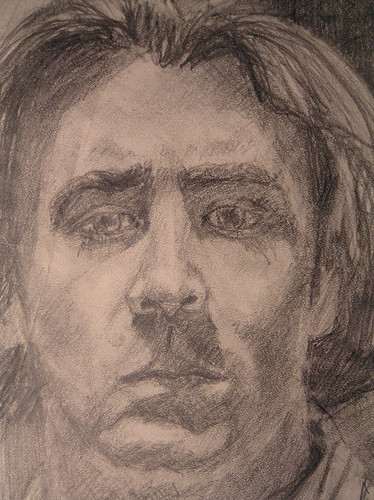

Part of a collection of Heads, Hands and Feet of people close


(Our bodies will return to the dust of the earth, and the breath of life will go back to God, who gave it to us. The Bible: Ecclesiastes, Ch. 12 V. 7)
The man dreams in his chair.
Runs home from the fields
to present this trophy
to his mother.
A living gemstone;
a Painted Lady.
Its life tickles his palm.
Lightly touches for air
in his fleshhouse hand.
He holds firm.
A boy's excitement not allowing this life
to flutter away.
Opening his hand for her
he starts at the stillness
of the creature's crushed colour.
He holds his fist tight again.
Tries again.
The butterfly is dead
again.
He can't go back
make it all better.
Opening and closing just pounds the thing
to dust.
An hourglass-trickle dunes at his feet.
He clenches his fist
in anger at the mess he's leaving
but can't stem the flow
no matter
how hard he tries.
The man sits in his chair.
He sits there for several days
in the exact
same
position.
Day after day
he cannot hear
the post that is collecting
for his daughter to reply:
"Unfortunately my father died
some time ago."
In his hands
clasped as tight as tight
she will find the breath
he refused to give back.
Useless
useless to him now.

Originally posted 4/3/07
The search for an ultimate definition of man has been a primary driving force in literature. The ‘Grand Narratives’ of Truth, History, God, Reality and Self have formed the basis for western literature, as authors have sought to find order and meaning in man’s existence. Whatever the final definition of ‘Man’, and there are many, the literary definition has ultimately been sought for in ‘Grand Narratives’. Lyotard defines Grand Narratives as ‘legitimating narratives’, and whilst they may be grounded in differing ideology like Marxism, Capitalism or Christianity, they all have one goal, and that “is called universal freedom, the fulfilment of all humanity.”i The three books that I am studying for this essay can be shown to reject the ‘Grand Narrative’, and can therefore be said to represent the death of Man as constructed in pre- twentieth century literature, although if we are to concur with Lyotard and accept that the definition of Man must include a search for ‘universal freedom’, then there are ways in which these texts merely supply an alternative approach, outside of universal Truth. ‘Man’ is a polysemic term, but for the purposes of this essay I will confine any definitions to western ideology, as the texts are only representative of western literature. Some of these terms are contradictory, and this list of possible definitions of Man is not intended to be exhaustive, it is merely aimed at highlighting the subjective nature of the concept.
Aristotle said that “Man is by nature a social animal...What is peculiar to men, compared to the other animals, is that they alone can perceive the good and the bad, the just and the unjust.” Christian narrative would define ‘Man’ in one particular way. The book of Genesis, in the old testament relates a creation story, in which “God created man in his own image, in the image of God he created him.”ii The book continues by telling of man’s fall from the garden of Eden. This creation myth would be one aspect to the definition of Man in Western society.
More generally, Man is the sum total of all that has gone before him. He is the culmination of history, tradition, culture etc., and this tradition is recorded through language: “Language allows humankind to possess knowledge of its own origin - the most important knowledge of all, and the content of the holiest texts, since the origin of human life and the ground of meaning are both presumed in (from) God.”iii Man has been defined as the “talking animal.”iv
The expression‘The King is dead, long live the King.’ acknowledges the natural cycle of life and death, and the continuum of society in which the individual is seamlessly replaced by another individual. The present instantly becomes the past, and the King is always the King, under the terms of this discourse. If the phrase is re-written, for the purposes of this essay as ‘Man is dead, long live Man’, then we can see how one construction or definition of ‘Man’ can be exiled to the past and a new definition appears in its place. The context in which a sign is used is crucial to its meaning, if the context is changed then the meaning changes also. This opens up all writing to almost infinite interpretations and destabilises its relationship with reality. If all writing becomes a fiction, and forms the context in which we define ‘Man’, then it can be said that ‘Man’ is a shifting paradigm, an amorphous term that responds to each new text. In this way all writing is about the ‘death of Man’, not just twentieth century writing.
What is apparent from this brief examination into the definition of man is that ideology affects the interpretation of ‘Man’ by prioritising certain interpretations of history over others. All definitions of Man can be challenged through the discourse of alternative ideology. For instance, Phillip Thody says, in opposition to Christian ideology, “The same principles of textual analysis which had been used for writers such as Homer or Thucydides, showed that few of the books presented as canonical by the church could possibly have been written in their officially received form by the authors to whom the church attributed them.”v He goes further by saying, “At the same time, there was no way in which the description of creation in Genesis could be reconciled with the evidence on which Darwin based his theory.”vi
Christian ideology and the existence of God provide the basis for a significant amount of western literature, and the search for meaning. Christian teaching defines western constructions of Truth, Self and History. Man is created by God, in his image, and can ultimately find everlasting life by following his word. Christian morality has been the foundation stone upon which western democracy and western law have been built. The Holy Bible of the Christian faith can be said to have defined western Man. Jean-Paul Sartre says of The Outsider however, “Since God does not exist and man dies, everything is permissible. One experience is as good as another; the important thing is simply to acquire as many as possible.”vii The main character in The Outsider, Mersault, who is on trial for murder, refuses to accept God, even when faced with execution. For him God simply does not exist, murder is a Christian tabooviii, and the law court in which he is tried is founded upon Christian ethics. “According to [the Priest], human justice was nothing and divine justice was everything. I pointed out that it was the former which had condemned me. He replied that it hadn’t washed away my sin for all that. I told him I didn’t know what a sin was. I’d simply been told that I was guilty.”ix Camus himself remarked on the absence of universal meaning, “I do not know whether this world has a meaning that is beyond me. But I do know that I am unaware of this meaning.”x In The Outsider the main character is isolated from, amongst other things, the western definition of Man. He is an atheist and therefore his behaviour is not governed by the principles of Christian ideology. Mersault is a man without a creed, without roots, and this freedom allows him to act, even murder, without regret; “I’d never been able to regret anything. I was always preoccupied by what was about to happen, today or tomorrow.”xi Ultimately Mersault only looks forward, and thus has no history to define him.
In Virginia Woolf’s Orlando we have another example of a text that questions previous definitions of ‘Grand Narrative’ and Man.
“Aspects of Woolf’s well-documented life have by now attained the status of intertexts, which interweave with her fiction and influence our interpretation of it. There is a kind of precedent for this interweaving of life and art in Woolf’s own blurring of the boundaries between them; in her production of diaries, letters and memoirs Woolf created a kind of interface between life and text, and herself questioned the barriers between them.”xii Orlando is a text that is concerned with its own creation. It is a metanarrative in many ways, constantly reminding the reader that it is a fiction with its references to other texts. The narrative, which follows the life of Orlando from boyhood to manhood and into womanhood, covers five centuries of ‘history’ and is called a biography. The text seems to be questioning the authenticity of history, constructed as it is through the texts of historians, and being, therefore, just one interpretation of a reality that is ultimately inaccessible. If all history is thus a fiction then the ‘biography’ of Orlando has just as much validity as any other historical document. “‘I will write,’ she had said, ‘what I enjoy writing’; and so had scratched out twenty-six volumes. Yet still, for all her travels and adventures and profound thinkings and turnings this way and that, she was only in the process of fabrication.”xiii
If writing is thus always a fabrication, then the Truth is unattainable. It is the words “The Truth” that awake Orlando, from the second of his/her sleep-like trances, and she has become a Woman,xiv in an ironic juxtaposition of interpretations of Reality. The longevity and the gender swapping construct a text that defies the usual perceptions of Reality. The novel could be described as magic-realist, in the way that extraordinary events are portrayed as accepted phenomena. Whatever the genre, the novel challenges the western definition of ‘Man’, particularly the very use of the word ‘Man’ to represent woman.
The novel constantly reminds the reader that our perceptions of history are constructed from works of fiction. When talking of the society of Pope, Swift and Addison Orlando is unable to give an example of their wit but says, “They were all very witty too, (but their wit is all in their books.” xv The reliability of memoirs is also challenged; “Was this life quite so exciting, quite so flattering, quite so glorious as it sounds when the memoir writer has done his work upon it.”xvi Woolf constructs an alternative history and, by using literary intertextuality, is able to argue its worth against traditional interpretations. Her character Orlando, further challenges western construction of Man by turning him into a her whilst continuing the construction of the character in the same fashion. “Orlando had become a Woman - there was no denying it. But in every other respect Orlando remained precisely as he had been.”xvii The patriarchal construction of Man requires Woman to be fundamentally different, inferior. Woolf quite clearly questions this assumption.
Paul Auster’s New York Trilogy takes the questioning of Grand Narrative a stage further. Like the Woolf novel, this text is a metanarrative and draws attention to its own literary construction. It is also intertextual and creates a fictional character ‘Paul Auster’ who is also the real author. In fact the use of names is particularly important to this text.
The New York Trilogy is in many ways a text book example of post-structuralist theory. Within post-structuralism the signifier and the signified are linked in an infinite chain of meaning and counter-meaning. The relationship between the signifier and the signified is arbitrary, that is there is no intrinsic reason why ‘cat’ should denote the animal in reality. Meaning is derived by way of the sign's difference from all other signs and ultimately there is no Truth. The meaning of a sign can only be expressed in terms of other signs, and the referent is thus unattainable. In The New York Trilogy Paul Auster explores this theory: Quinn introduces himself to Peter Stillman as Peter Stillman. Peter Stillman replies, “‘That’s my name,’. When Quinn says he is the other Peter Stillman, Peter Stillman replies “Oh. You mean my son. Yes , that’s possible. You look just like him.”xviii The arbitrariness of the relationship between the signifier and the signified is layed out here. Peter Stillman as a signifier refers to two concepts, and only looks like Peter Stillman on the page. The characters do not exist except as letters on the page. The novel is unfathomable, with layers of narrative voice piled nine or ten layers deep. Each section begins under the pretence of a detective novel but the answers are never exposed. In this novel the Truth is categorically not out there. Reality has ceased to exist in the fictional world and the text deconstructs western Man.
Western literature, before the twentieth century, has searched for ultimate Truths, Reality, a definition of the Self, God, and knowledge of Historical fact. The examples of twentieth century writing examined here challenge the idea that there is any intrinsic meaning to be found, and can therefore be said to be concerned with the death of Man as defined in pre-twentieth century literature. If post-structuralist theory is taken up however it could be said that all writing redefines, in however small a way, ‘Man’, and is therefore also concerned with the death of Man. If reality is always mediated through language, and one type of language is no more valid than another, then all writing forms part of the body of evidence from which an individual will construct a definition of Man, and so all writing, not just twentieth century writing, is concerned with the death of Man.
iJean-François Lyotard (1992), The Post-modern Explained (Minneapolis and London: University of Minnesota Press) p.25
iiThe Holy Bible: The New International Version (1984), (London: Hodder and Stoughton) Genesis Chapter 1 verse 27
iiiArt Berman (1994), Preface to Modernism (Urbana and Chicago: University of Illinios Press) p.90
ivJonathon Barnes (1982, Aristotle, (Oxford and New York: Oxford University Press,) p.17
vPhilip Thody (1996), Twentieth Century Literature: Critical Issues and Themes (Basingstoke and London, Macmillan Press) p.6
viibid p.6
viiJean-Paul Sartre (1955), Literary and Philosophical Essays (London: Hutchinson and Co. Ltd.) P.27
viii
The Holy Bible: The New International Version (1984), (London: Hodder and Stoughton) Exodus Chapter 20 verse 13
ixAlbert Camus translated from the French by Joseph Laredo (1982) The Outsider (London: Penguin Books) p.113
xJean-Paul Sartre (1955), Literary and Philosophical Essays (London: Hutchinson and Co. Ltd.) P.34
xiop. cit. Camus (1982) p.97
xiiClare Hanson (1994), Virginia Woolf (Basingstoke and London: Macmillan Press) p.1
xiiiVirginia Woolf (1993) Orlando: A Biography (London: Penguin Books) p.124
xivibid p.97/98
xvibid p.147
xviibid p.148
xviiibid p.98
xviiiPaul Auster (1988) The New York Trilogy (London and Boston: Faber and Faber) p.84
Returning to an Abandoned Village
no thing
.............. ex cept
the should be
but isn't
di ..... vide be
........................ tween
too long ago
...................... andnow
A trick of the
me mory
or a lapse of the
............................ light
perhaps
No .............. thing
............................... certainly
to match a re ................ collection
of child
.............. hood
(two)
a familiar sense
of geo
............ graphy
an aware ............. ness
of pointing
in the right direct
................................ ion
of be ing aligned
true
turning the right
............................. way
to face
what is not
.................... now
but was
............... then
A notion that this space is
still
...................... that space
(one)
a dark patch
a once wet
stain on stone
proof of the exist
............................... ence
of it all
of
every
........... thing
Click here to comment
TRANS… (York 9)
now then
you asked me
to respond
not ex
plain de
scribe
tell
the truth
lies
between the road’s
surface
lieslieslieslieslieslieslieslieslies
and its verge
ing on the herenow
of …fixed moments
--------------------------
…ported
to the present
fixed point
each conscious of an ex
act
location
heldholding you then to now
now to then
--------------------------
y our me
mories blink
im
patient
ly in
untime to the beat
ing
cars
you exist
now
only in the gaps in traffic
you exist
then
through the windscreen
across the bonnet
all over the metalled
arterial sur
face
that exists now
and then
now
then
nowthen
now then
there
there
there
therethere
is that better now
then

TRANS…
now then
you asked me
to respond
not ex
plain de
scribe
tell
the truth
lies
between the road’s
surface
lieslieslieslieslieslieslieslieslies
and its verge
ing on the herenow
of …fixed moments
--------------------------
…ported
to the present
fixed point
each conscious of an ex
act
location
heldholding you then to now
now to then
--------------------------
y our me
mories blink
im
patient
ly in
untime to the beat
ing
cars
you exist
now
only in the gaps in traffic
you exist
then
through the windscreen
across the bonnet
all over the metalled
arterial sur
face
that exists now
and then
now
then
nowthen
now then
there
there
there
therethere
is that better now
then
The Red Letter
Right from my first encounter with her, from the moment she became present to me, a sense of ending has eclipsed all beginnings. She dies, naturally. Or rather she was always already dead, long before I ever heard myself speak her name. This is the only fact I have for certain. The only clear sighting of her. The closer I get to her self, her body, the further I fall into her story, the closer I get to losing this.
It was 1864 when I met her. That's how I know she's dead. People just don't live that long. Even so I ended up having to prove the fact to myself. I know she's dead because I have stood at her grave. Her death only real in the experience of the moment. I looked at her simple inscription and read the words of yet another voice trying to recreate her in my imagination. But as I stood, attempting to put her decayed flesh back on her muddied bones, I realised there was nothing of her there. Nothing beneath my treacherous black shoes save for trace elements and a few bones. The future's archaeological exhibit, my digging was to be done elsewhere. Standing on her well-fed grass I read an inscription so out of date it is now a lie.
* * *
HERE LIES THE BODY OF
ANN WILSON
1845-1907
R.I.P
* * *
We moved into this house, my wife and I, just over two years ago. I'd been working for a magazine in London but, for one reason and another, had decided to devote more time to my own writing. City life had its advantages, its convenience, but a hurried sense of completion had begun to overtake me. I felt as if life was geared towards destinations. I felt as if I was careering towards the end of the road. The question was always there, waiting to be asked: "Where are you going?"
"So where do you see yourself five years down the line?"
"Well, I suppose part of the answer depends upon the company's response to my recent success. I feel I've displayed the correct approach and my work has been of a high standard. I think that if I were not invited to join the senior management team within the next eighteen months, I would have to look at my options. In the longer term I'd like to be able to invest enough to ensure an early retirement, possibly at fifty-five."
Eventually, that kind of communication, always selling yourself or buying others, tired me out. I became uneasy about my own complicity in a system that encouraged such mapping. My life had become a commercial orienteering course, with a time limit and controls. My position, me, I supported all this.
I sold my shares in the company, a bonus following a good year, and then sold our three-bedroom terrace. The profits, and the relative price of rural housing, enabled us to but our dream family home in the country.
The house was, and still is, full of rustic charm and original features, but it needed some renovation to suit my purposes. The roof space had clearly been used in the past. It had a complete staircase to it, not just a loft ladder, and it was boarded and panelled. It had no windows however, and following a readjustment of the designs at the request of the local authority, work began installing a westward facing dormer window. The views across the fields, away from the village centre and the distractions of rural gossip, would be inspirational.
It was during the construction work, knocking a hole out of the roof to be precise, that my involvement in her affairs began. That room's first natural light since the original builders had incarcerated it poured in. In a whirl of fresh air, papers stirred. Discovered under the panelling a newspaper cutting from the Hampton and Westbury Post, dated Tuesday 6th December, 1864. The light had given up a secret, a story waiting to be told.
* * *
Standing proud at its very heart, St. Swithin's church dominates the village of Stourton and its surrounding parish. The church tower stands out from the countryside, commanding a position like the great cathedral at Chartres, only smaller. Reverend Thomas Hardy, the parish Rector, liked to remind his attentive flock on a Sunday that, "the Lord, our Shepherd" kept watch over all of them from that tower. He Himself had been to the top of it and had "seen into every household in the village." There could be no secrets from His gaze.
* * *
My wife rarely ventured upstairs to the attic. My writing had nothing to do with her. I suppose that's what she thought. She wouldn't have understood anyway, and a row would have broken out over those annoying questions: "Is that meant to be us then?"
She seemed to be content to keep house and visit friends, although many friends had too many children and too little time for people like us. She managed to busy herself though and was always in bed long before me. This allowed me the chance to take this project seriously, to become more intense. Pretty soon I didn't even notice her footsteps not mounting the stairs.
* * *
Living in the shadows of candlelight for most of her days, the kitchen was in a windowless basement, Ann usually resented her place. On Sunday evenings, following Hardy's sermons though, she was glad she had a room in the attic. Windowless, and only imaginatively looking out over the fields, she felt protected from this intrusive stare. She would climg the stairs, remove her Sunday hat, her dress, her corset, and lay aside that overtired, overworked and overlooked Ann. Away from the gaze of that ancient building she felt free to explore her own body. She would hold her swelling belly and feel her child moving against her flesh. Her secret gave her an identity, prevented her being consumed. She would sing to it, old field songs her grandmother had sung. And she would love it. Love it without knowing it. Love it without needing it.
This was not a room of her own, though. Ann shared it with Jane, Jane Preece the housemaid, but this didn't interfere with their liberties. Ann in particular felt very lucky to find someone to relate with. She had heard many stories from her sisters of overbearing generals and the loneliness of such company. Even without the complications of her confinement it was common for girls in small households to be isolated. Mrs. Sutton's was certainly a small household. She knew how lucky it was for her to have found a friend in Jane, and how they were both lucky that the only other servant, Tom the gardener, was amiably disinterested in everything bu gardening. The situation meant that Ann had been able to conceal her predicament, free from the rumours of a larger household or an older colleague.
On these Sundays Jane would often lie naked alongside her and they would wish the world to stop. The incessant growing of Ann's belly, the ever-stronger kicks and convulsions, her painful breasts and darkening nipples, reminded her of her position. She was aware of an impending doom, an ending that could not be prevented. She wanted to remain pregnant. She didn't want to have, couldn't have, a baby.
* * *
"Jane," Ann ventured one night. "Will you promise me something?"
"Well, you know, my dear, it all depends. But I will try. Of that you can be sure."
Ann fiddled with her belly button. It looked like the knotted end of a balloon. In recent weeks it had begun to protrude and itch. She looked intently at her companion.
"I hope I never ask you anything you are unable to do. I should hate myself if I ever gave you cause to compromise yourself. I ask only that you write to my mother for me, if anything should happen. I have such very bad feelings at times, such dark thoughts, and I should like for her to have another chance."
Jane smiled and placed a hand on the younger woman's thigh.
"Of course I shall, if you wish it. But please, consider writing yourself, now whilst you can. I should think you far more able than I. Please, write yourself. I shall fetch you some paper.
Jane began to rise, but Ann snatched her hand, preventing her withdrawal.
"No. I fear it would do more harm than good. Perhaps some dreadful news will work instead."
* * *
It didn't take a lot of research to find out that the house we had moved into was the same house that Ann Wilson had lived and worked in so many uears ago. A morning's work at the church records was all it took to trace Ann to Rose Cottage, our Cottage. There were times when I felt so close to her the room would fill with pain. Her screams muffled to avoid attention, invading my privacy.
As close as we were though, as much as I breathed life into her, I could do nothing for her daughter, who never lived long enough to be recorded. It is here in this place that in fear, next to me in space, if not in time, her delicate little spine was almost broken in two. An attempt to hide her from prying eyes.
Out of compassion for her mother, to alleviate Ann's suffering, I gave her Jane Preece. There are no records of her either, but what else could I do?
* * *
Midnight. Pitch dark. She sits, awoken by a sense of unease, an almost unnoticeable anxiety. She fumbles her hand in the direction of the dressing table, finds the candle and takes the edge of the room's blackness. It is as cold as the air outside. Her breath, clouding in great pillows, searches out and flees from the draught-cracks in the panelling. Her bulk is alien to her for the first time. And the the first realisation of the wetness, brought to light as it cools around her buttocks and thighs. The shiver is followed by a faint and yet distinct contraction. It is beginning.
* * *
When Jane finally awoke, woken not by the rising sun but by a sense of its rising, she rolled over to see Ann clutching at her knees, as if to bring them to her chest, but impeded by the enormity of her distended self. She was rocking slightly, and no words were needed. Jane's comprehension was instant and complete.
Dressing quickly, Jane mapped out a plan. She would begin the hidden chores. Lighting the fires, boiling the water, preparing the breakfast. She could leave Ann in bed until the household, until Mrs Sutton came downstairs. But Ann would have to make an appearance, to fit the plan. She must be seen around the house, behaving normally. If her absence were noticed then there would be questions, and as illness could be the only acceptable excuse from duty, the doctor would be called. Mrs Sutton was careful her staff should be treated correctly. If the birth could be kept secret then the baby could be hidden until nightfall, and then, under the cover of night, it could be taken away. Jane already knew where to take it.
Initially everything went well. Ann's contractions were only mild at first and well spaced. Just once did she have to positively lie, as she winced and instinctively grasped her stomach.
"No, ma'am. A little indigestion, nothing more."
She had quickly retreated, promising to take a little time to drink a glass of milk.
"Milk is by far the best thing for digestive complaints my dear. Be sure to take a glass. But mind you don't neglect your duties."
* * *
With me busy writing and my wife doing whatever it was she did, we had less and less time together. We hadn't been physical since we moved in to the cottage. Something had come between us and yet everything we had was part of the plan, mapped out from the day I had proposed to her. I asked her once if anything was wrong.
"Just a little run down." That was all I could make her say, but I knew there was more.
* * *
By mid-afternoon, following a difficult luncheon period, Ann found it hard to continue the performance. She desperately wanted to find a quiet corner, to roll up like a cat and wait to be discovered with a delightful litter by eager children. Twice she had to answer the doorbell. Jane had forced her to.
"You simply must. It will help later, you'll see. It will stop them asking questions of you. Carry on as normal. I shall follow and wait in the scullery. I shall wait and help you back upstairs. Now quickly, there's the bell again! Mrs. Sutton will soon want to know why you have taken so long."
After the second of such trips, Jane realised that the time was close. They would have to hop that she was not required again.
* * *
There was no fear in the room that afternoon. Each had experienced childbirth at home. It was all a natural part of life in an industrial town. But just as there was no fear, there was also no excitement, no expectation. Ann squatted on all fours on the bed, her face buried in her pillow. Jane assisted, rubbing her back, cooling her head with water. She would run her fingers inside her feel for a head, to prevent a tear.
Ann, her buttocks spread apart, bearing down, her vagina stretched white, expelled a girl in a ruch of wet and blood and excrement.
* * *
Dressing as soon as she could stand, a towel beneath her underwear, hidden by her uniform, she answered the door again, only half an hour later.
Reverend Hardy didn't make the connection between the desperately pale and tired servant who opened the door for him and the story he heard as a magistrate much later.
When she returned to her room she wanted to lie down and dream of a full belly that moved of its own accord. When she finally made it to the top of the stairs and enteredf her room she barely noticed the clean sheets, the fresh smell of incense and the absent child. She caught a glimpse of Jane sliding a box beneath the bed and she knew enough.
* * *
She struggled through the following days, taking time off only to replace her bloodied towel. She continued to leak constantly from a wound that could not heal. By Tuesday she was drained and Jane was forced to ask Mrs. Sutton to call a doctor. Ann had been unable to rise that morning, she had a fever, and at times she had failed to recognise her. Still Jane felt she was letting her down, somehow betraying her trust.
* * *
Doctor Scott lifted back the bed covers and felt Ann's baggy stomach. He knew. Touching her was his proof. Ann followed his commands. She lifted her nightdress and unpeeled another soaked towel. She lifted her nightdress and exposed herself to him. The doctor pushed her knees further apart and entered her, his fingers inspecting, cleaning and stripping. He had to satisy himself that nature had taken its course.
The doctor stood back and wiped his hands clean while she looked on. She had seen a man do that before, or so she thought.
"You have recently been delivered, Ann, have you not?" The doctor's tone was soothing, mesmerising.
"No, sir. I am just a little drained." Ann avoided his eyes. She looked all around, blinking hard.
"Now, my dear, you can't hide the truth from a man of science. I know everything. Now, tell me what has become of the child?"
When she gave him the key she felt as if she were betraying Jane. She wondered what would happen to them, but the doctor's words gave her the idea.
"Was she dead when you put her in here, Ann?"
When you put her in here.
"Yes. Yes, of course," she answered and added rather distractedly, "when I put her in here."
Doctor Scott prised the baby from the chamber pot and Ann saw her for the first time. She wondered how something so tiny could have made her so large, left such a hole. She hugged her stomach and imagined the movements she had once felt. She looked at this doubled baby, clutching itself.
* * *
"I'm leaving you," she said.
"But where can you go without me? It doesn't make sense." Her voice was decided. I knew then that I had been waiting, from the beginning, for this. We had reached the end of the road.
"Anywhere. I have another life out there. There can be me without you."
"No, you belong here, your place is here. I've given everything that could be given. What more could I do?"
"But it's a gift that takes. You only gave me what you wanted me to have. You pictured me here. You created this life for me here."
"I don't understand. What happens next? What happens to you now?"
"I'll go to my mother's for a while, then I'll disappear. I'll go far away, out of sight."
"But you were nothing before I found you."
"No. I was something, something you didn't know. Something you have never known."
"I won't let you leave."
"You can't stop me now."
* * *
She answered concisely in court, although her words had huge import for Ann. This was her was of reconciliation. She had not replied to Ann's letter and had therefore allowed Ann to maintain a picture of their relationship based upon her sending away, upon her disgrace. Now her testimony erased that divide. Her mother's presence and her plain answers, answers that conealed much but did not exactly lie, warmed Ann briefly, hopefully.
"I reside in Grantchester, and am the mother of the prisoner. I don't know exactly how long my duaghter has been in service with Mrs Sutton. I last heard from her about three weeks ago, when she told me she was well, and comfortable, and had a good situation. She also said she hoped to be with me at Christmas."
Mother and daughter surveyed each other, warmly. Somewhere she remembered Jane's letter.
* * *
Reunited with her mother, she disappeared from my world. A chapter in her life, in our lives, was over and I imagined I wouldn't see her again. Often I find myself, alone now, looking over the fields at a scene identical to the one she could have seen had she been here now. I try to picture her not as she really was, but as I like to remember her.
The End
Voicing Concerns
Rob Cooper
Postgraduate Certificate for Educational studies:
Education for Citizenship
Module 2
Voicing Concerns:
From exclusion to engagement
Citizenship Education for SEN Students
Acknowledgements
I would like to thank Roy Leighton, of Independent Thinking Ltd, who at a training conference four years ago reinforced my faith in a creative approach to teaching and as a consequence of this made me realise that I was in the wrong job.
Contents
| Abstract……………………….. | 4 |
| Introduction…………………… | 5 - 6 |
| Literature Review……………. | 7 – 10 |
| Methodology…………………. | 11 - 13 |
| Action and Findings…………. | 14 - 16 |
| Analysis and Discussion……. | 17- 21 |
| Conclusions………………...... | 22- 23 |
| Bibliography………………...... | 24- 25 |
| Appendix 1 – List of Learning difficulties and Disabilities | |
| Appendix 2 – Student participant literacy levels | |
| Appendix 3 – Intervention day activities outline | |
| Appendix 4 – Video activity questions | |
| Appendix 5 – Student response transcripts | |
| Appendix 6 – Citizenship topic images | |
| Appendix 7 – Full data sheets | |
| Appendix 8 – Action research project framework | |
Abstract
My Action Research Project aimed to discover the local, national and global Citizenship concerns of students with Special Educational Needs (SEN) using creative teaching strategies based on Howard Gardner’s Multiple Intelligences.
Data was collected through a non-verbal, interactive questionnaire, teacher observation, witness statements and video.
My main findings are that my students are significantly more concerned with global rather than local or national issues. They are interested in technology but are worried by diversity. They regard politics as boring. They are able to engage thoughtfully with issues if material is presented appropriately.
Introduction
I am Head of Citizenship at a Special school. All students have a statement of Special Educational Needs (SEN). For a full list of their Special Needs, see appendix 1.
It has been said that action research starts as a “’living contradiction’; that is, feeling dissonance when we are not acting in accordance with our values and beliefs.” (McNiff, Lomax and Whitehead, 2003 :59) This seems especially apt.
There is a clear contradiction between inclusive education and special needs education. I am acutely aware of the tension between my role as Head of Citizenship where I represent the values of diversity and inclusion and have a responsibility to promote community cohesion, and our status as a special school where potentially we are a contributory factor in the marginalisation of our students from mainstream society.
Social Exclusion and its impact upon the local, national and global citizenship concerns of my students is therefore the first conceptual framework of this research project.
There is also contradiction in the concept of student voice for students with communication difficulties. If teachers are to respond quickly to contemporary issues and deliver relevant lessons for the students in their classes, there has to be some kind of dialogue between themselves and young people but with SEN students this dialogue is difficult to initiate.
I regard myself as an advocate for the Special Needs Students that I work with, speaking on their behalf, but I also have a duty to ensure they are given the skills and opportunities to speak for themselves.
Consequently, Student Voice is the second conceptual framework of this research project.
I was fortunate to attend a conference recently at which Roy Leighton was the guest speaker. I was very much looking forward to hearing him again, as the first time I heard him speak had a profound effect on my career pathway. He opened with a point that can be easily lost amongst all the day to day practicalities of teaching in a busy school: “It’s the brain, stupid!” (Leighton, 2009)
I find it incomprehensible that as a PGCE student I received no training in brain structure and how we learn, despite the fact that this incredible organ should be the teachers’ single focus of attention. The workings of the brain and in particular how people learn, takes on extra significance in my working life when we consider two facts: Traditional teaching uses language as the primary means of communication; and the students at my school have significant language and communication difficulties.
How a creative approach to teaching and learning enables Special Needs students to access the Citizenship curriculum represents the final conceptual framework of this research project and is the third of the contradictions that have led me here.
Not only do my students face the everyday concerns of typical teenagers living in Britain today, they also have to face the specific concerns related to their disabilities and learning difficulties. I am committed to ensuring that our Citizenship programme should allow them to identify and explore those concerns but I am not disabled, I do not have learning difficulties and I am not a young person growing up in 21st century Britain.
Clearly, I am not the best person to decide what my students concerns should be.
Literature Review
Social Exclusion
Social Exclusion is, “a shorthand term for what can happen when people or areas suffer from a combination of linked problems such as unemployment, poor skills, low incomes, poor housing, high crime environments, bad health, poverty and family breakdown.” (www.cabinetoffice.gov.uk)
The specific effects of Social Exclusion on young people are wide and varied but generally, “it can significantly damage their physical, mental and social development.” (Ruxton, 2001, p.71)
I would contend that Social Exclusion should also include a more general acknowledgement of the marginalization of young people that we witness today.
The Times newspaper recently published an article under the headline, “Most adults think children ‘are feral and a danger to society’.” (www.timesonline.co.uk) and The UN Committee on the Rights of the Child (UNCRC) suggested that the UK government should be, “Taking urgent measures to address the intolerance and inappropriate characterization of children, especially adolescents” (UNCRC, 2008).
There is clearly a danger that young people are increasingly likely to be marginalized from society simply because they are young people. In fact Goldson goes one step further and talks of the, “Demonization of Children.” (Goldson, 2001: 34)
Lansdown lists specific examples of how young people have been excluded from mainstream society: “The introduction of powers to impose child curfews, the refusal of many shops to allow children in and the decision by the Millennium Dome to refuse entry to the under 16s if they are not accompanied by an adult.” (Lansdown, 2001: 92)
Learning Difficulties and Disabilities are also a factor in this wider sense of marginalization. As Ruth Marchant points out, “Disabled children face major barriers to being included as equal members of society.” (Marchant, 2001: 217)
My students all have Learning Difficulties and Disabilities and are, “more likely to be brought up in poorer socio-economic households than non-disabled children.” (HM Treasury, 2007: 8) They are also young people. For these reasons, I conclude that the students I work with are at significant risk from Social Exclusion and I believe that Citizenship Education, especially through Student Voice, has a special and significant role to play in helping them to identify and face up to the challenges posed by their status, or lack of it.
Student Voice
On the status of children in society, Wendy Rogers identifies two dominant political discourses at play: The discourses of welfare and of control (Rogers, 2001: p.30). Each frames social and educational policy as being done to children.
These ‘traditional’ discourses are being challenged by a new discourse which sees the status of children shifting from that of recipients to participants (Roberts, 2001: 64). In this new discourse of participation, “children do have the right to be heard” (Thomas, 2001: 105) and it manifests itself in schools as Student Voice.
According to Jean Ruddock Student Voice is, “the consultative wing of pupil participation” (Ruddock, 2005: 1) and is born out of Article 12 of the 1990 UN Convention on the Rights of the Child, which provides that:
“States Parties shall assure to the child who is capable of forming his or her own views the right to express those views in all matters affecting the child, the views of the child being given due weight in accordance with the age and maturity of the child.”
Whilst Benton et al (2008), Roberts (2001) and Thomas (2001) all identify this shift, Student Voice is still very much in its infancy. In their response to the UK’s 3rd and 4th reports on The Rights of the Child in 2008, the UN expressed concern that, “Participation of children in all aspects of schooling is inadequate, since children have very few consultation rights” (UNCRC, 2008: 1) Clearly, this policy shift has not yet translated into practice.
Ruddock argues that Student Voice provides an opportunity, “to hear from the silent – or silenced”. (Ruddock, 2005: 2) Given that my students are at significant risk of being silenced through social exclusion, the potential benefits are great. However, Ruddock also points out that it, “assumes a degree of social confidence and of linguistic competence” (Ruddock, 2005: 2) and so in my professional setting, the challenge is to find a way to listen to students who either have no voice or they have a voice that is difficult to hear.
Creativity in the Classroom
Education has been a key public and political issue since at least the 1944 Education Act when Education became one of the three pillars of the new welfare state (Tomlinson, 2001: 9) and as such it is always subjected to pedagogical challenge. Everyone, it would appear, has an opinion on education.
Sir Ken Robinson verbalises one such opinion which seems to be gathering momentum: our education system fails to prepare children for the 21st century world that they will grow up in (Robinson, 2006 and Robinson, 2008). Something needs to change and recent government policy reflects a desire to affect this change.
The genealogy of this desire begins at policy level with the government green paper, Every Child Matters (ECM) in 2003, and the New Secondary Curriculum (2007) and The Children’s Plan (2007) that emerge from it.
With its five outcomes: be healthy, stay safe, enjoy and achieve, make a positive contribution and achieve economic well-being, ECM directly informs the New Secondary Curriculum which, “should enable all young people to become: successful learners who enjoy learning, make progress and achieve; confident individuals who are able to live safe, healthy and fulfilling lives; responsible citizens who make a positive contribution to society.” (QCA, 2007: 7) Significantly, embedded within the New Secondary Curriculum as a cross-curricula dimension is creativity, which Sir Ken Robinson identifies as the central vehicle for affecting change: “Creativity now is as important in education as literacy, and we should treat it with the same status.” (Robinson, 2006)
Whilst, “The literature in the area of ‘Creative Learning’ generally, is patchy and emergent” (Craft et al, 2006: 35), Peter Woods defines it as being “characterized by innovation, ownership of knowledge, control of teaching processes and relevance to the learner” (Woods, 2001: 75). In government policy, Creative learning manifests itself as Personalised Learning, which has, “Achievement, aspiration, inclusion (…) and accountability” (West-Burnham, 2008: 8) amongst its components.
Personalised Learning is at the heart of the government’s vision for education in the future: “We intend to create a system in which no matter what level a young person is learning at, and no matter what their preference for style of learning, they will have access to a course and to qualifications that suit them." (DCSF, 2009: 4)
“Style of learning” is a key element of Personalised Learning. David Milliband talks of Personalised Learning as requiring strategies that “accommodate different paces and styles of learning.” (Milliband, 2004) Both cases refer to pedagogical principals rooted in the theory of Multiple Intelligence developed by Howard Gardner in his book Frames of Mind (1984)
Whilst Multiple Intelligences and learning styles, or the “crude reductionism of specific learner types” (Milliband, 2004), that leads to the VAK activities commonly seen in lesson planning, are not automatically synonymous with creativity, Gardner’s is a key text within this particular framework.
Methodology
Howard Gardner notes that, “Much of teaching and learning occurs through language” (Gardner, 1984: 78) which is a problem for students whose literacy levels are very low compared with national expectations (See Appendix 2); the traditionally dominant mode of education actually represents a barrier to learning. Therefore the main feature of my methodology is the restricted use of data collection methods that make linguistic demands of my student.
Instead of using traditional student questionnaires which would have been both too difficult for students to complete independently and too unwieldy to manage if administered with one to one support, I designed a series of activities which can be regarded as a non-verbal, interactive questionnaire. Each activity represents a single question where students respond to a set of images via mainly non-verbal means based on Gardner’s Multiple Intelligences. For fuller details of the intervention activities see appendix 3.
A class of 10 year 9 students took part in the questionnaire which was administered on an intervention day held in a gym with appropriate audio-visual facilities. The class was chosen as being representative of as wide a range of socio-economic backgrounds, and learning difficulties and disabilities as possible within a single class.
Of the 12 activities planned, only 10 activities were completed due to time constraints. 6 asked the students to identify sets of images as being positive, negative or neutral. 2 asked the students to rank order sets of images. 1 activity asked the students to match images to pieces of music and a final activity asked students to match emoticons to statements about their local, national and global communities. Of the ten activities run, all but one asked for non-verbal responses.
For most of the activities students were asked to respond in terms of whether they felt positive, negative or neutral about the images presented to them. Positive was introduced as an image that they would like to learn more about. Negative was an image that scared them. A neutral image was an image that bored them or one they had no opinion on. These terms were simplified further to good, bad or boring.
In response to some sets of images, students were asked to rank order the them according to levels of interest, but these responses were framed in a similar way: Good through to bad.
The simplicity of the terminology was intended to reduce to a minimum the possibility of misunderstanding but misunderstanding could not be eliminated entirely. One reason for this is that the citizenship topic to which each image was attached was open to a degree of interpretation.
Student responses were recorded by the Learning Support Assistants (LSAs) on data collection sheets specific to each activity.
One potential weakness of the data collection methods comes from this necessary simplification in that it denies the possibility of any alternative, appropriate responses. To counter this, I chose to collect additional data through staff reflection, video recording and photographs.
Students were encouraged to use a video camera and an LSA was assigned to help them operate this. This gave individual and paired students the chance to respond either to a range of predetermined questions (Appendix 4), or to respond to the activity just completed. This data would also help me to determine the effectiveness of the teaching methods not just through the content of their verbal responses but also in the non-verbal signals of their expressions, gestures and body language. These kinds of responses would also be recorded via reflections from the staff involved and through photographs. Cameras were made available for staff and students to use. Examples of this ‘soft’ data can be found in appendix 5.
Students were also provided with drawing equipment and encouraged to draw their responses to the activities. Whilst this proved to be an effective classroom management strategy between activities, the data it provided was less useful, being too difficult to decode.
In working with students with Learning Difficulties, there were clearly ethical issues to consider. In the planning stage, I consulted with our Assistant Head to check that my proposition was reasonable. I spoke directly to the class about the intervention day prior to the event, clarifying what they would be doing, why they were doing it and giving them a clear opportunity to withdraw themselves. I also sought written permission from parents and carers via letter using simplified language as many of them also have learning difficulties. One student was withdrawn from the event at the request of the parents.
Our students very often find a change of routine difficult to cope with and so whilst I was keen to design an inspiring and creative intervention day, I was also well aware that I would have to carefully manage the stress and anxiety that such a day may cause.
I designed the layout of the gym area so that each student would have an identified intrapersonal area. This would give them a refuge to return to and it was made clear that they could sit out any of the activities if they felt they were too challenging. Several students took up this option and this explains the varying number of responses recorded for each activity.
As well as these private spaces, I also provided interpersonal spaces with activities and distractions related to the day. In the setting up period between activities, students were encouraged to sit in these communal areas and interact with each other in this space. The drawing and video activities were located here.
I also made it clear on the day that students could return to timetabled lessons at any moment if they chose to do so. One student on the day took up the option to return to class, finding the day too difficult.
Action and Findings
Each activity had two aims. Firstly, it aimed to find out the global, national and local Citizenship topics of interest to the students both in positive and negative terms through consultation and participation. The results would hopefully allow me to identify areas of interest, fear and anxiety and these results could later be used to revise the key stage 4 curriculum to make it relevant to the students.
Secondly, the data would allow me to analyse which delivery methods were most engaging and that enabled the students to participate in a dialogue about the future content of their Citizenship programme most effectively.
The majority of activities were based on sets of 9 images that represented one of each of the chosen Citizenship topic areas; Environment, Animals, Technology, Poverty, Law, Freedom, Politics, Diversity and Conflict. These represent a broad a range of citizenship topics but I acknowledge that they are largely arbitrary and not comprehensive. The images used can be seen in appendix 6.
I was clear from the start that I wasn’t simply looking for the images that elicited a positive response. The negative responses to images might reflect common concerns and misconceptions that would need to be addressed in curriculum time.
The full data sheets showing the results from all activities can be seen in appendix 7.
Main Findings
Whilst the activities simplified student responses as much as possible, the different methods for collecting responses seemed to affect the outcomes. In the 6 activities that asked students to decide whether they thought images were positive, neutral or negative, technology was clearly perceived as being positive. Images of law and diversity were seen as equally negative. These results broadly matched my expectations of the attitudes of typical teenagers.
In the 2 rank order activities, politics was perceived most negatively with diversity also seen as negative. Freedom was seen in the most positive light in these activities. Some of the findings from these rank ordering activities seem to contradict each other and suggest that the activity represented something of a barrier to the students understanding.
In the musical intelligence activity, animals and politics were chosen most often, although whether any conclusions can be drawn from this will be discussed in the next section.
The final activity shows that students are clearly more concerned by global issues than local and national issues and may reflect a lack of engagement with communities closer to them as a result of various forms of social exclusion. Alternatively, students may be influenced by high profile international news stories in the media at the time of the intervention.
In terms of the activities and teaching methods, it was clear that the students responded positively to the day as a whole and were boosted by the sense of empowerment that came from being consulted in this way. The day was very demanding on them however, with most students exercising their right to sit out at least one activity.
Students were engaged by the use of interesting and challenging images. The kinaesthetic activity where students expressed an opinion through body shape proved to be the most difficult for students, challenging the perception that SEN students respond best to kinaesthetic activities. Other practical activities were popular however.
it is clear that proper consultation of SEN students makes extraordinary demands on the school in terms of resources and time. This was in essence a 12 part questionnaire that could be administered to large numbers of mainstream students in a very short space of time. With SEN students, the 12 questions had to be reduced to 10 questions and took up an entire day and required a huge amount of planning and extra resources. This is also very demanding on the students who were actively and energetically involved in learning for 5 hours in total. In the case of one student, the demands were too great and they returned to class. These are important considerations for teachers and senior leaders to take into account.
Analysis and discussion
Figure 1 shows all student responses from activities 1, 3, 5, 7, 9 and 12. Negative responses were given a value of -1, positive responses +1 and neutral responses 0. The totals for each topic image were then added together across the 6 activities. The adjusted total represents these totals minus the highest and lowest scoring images from each topic. Removing the extreme results helps negate the effect of strongly emotive images.

Figure 1 suggests that students are interested in technology, are bored by politics and have a negative attitude to freedom and diversity.
Figure 2 presents the average results from activities 2 and 4 where students discarded images in rank order, with the intention of retaining the image that was of most interest to them. This image was given a value of 1. The first image discarded was given a value of 9. Therefore, the lowest values represent images perceived most positively. Here, freedom seems to be the most interesting topic to students. This contradicts figure 1. Similarly, whilst politics is clearly boring in figure 1, in figure 2 students seem to have a strongly negative response to politics.

There are two possible explanations for these contradictions. In rank ordering activities like activities 2 and 4, where 1 represents a positive response, a value of 9 can be interpreted as representing either a negative or a boring response. So, whilst low numbers can be regarded as being a fairly accurate reflection of an overall positive response, the meaning of higher values is less clear. So, figure 2’s results may support the findings from Figure 1 with politics again being regarded as boring rather than negative.
The second possibility is that a rank ordering activity is much more complex and students with dyslexia and similar organisational difficulties may be disadvantaged by this learning activity.
In figure 2, poverty, which is seen as very positive in activity 2 and either boring or negative in activity 4, produces conflicting results within the same data collection method. This may be because the students were more interested in the image representing poverty in activity 2 because a child was depicted in it. If more rank ordering activities had been conducted then it could have been possible to eliminate the extreme results as done for figure 1 and the effect of over emotive images could have been countered.
In activity 8, students were given a choice of images after hearing each of 6 pieces of classical music. The music was intended to represent either positive or negative moods, with the pieces alternating between the two. However, during the activity it was clear that students interpreted the moods differently and therefore the data from this element of the activity has been ignored. Figure 3 records how many times each image was chosen. The music seemed to influence which images were chosen – no student remained rooted to one image – but how the music was interpreted by each student is difficult to say. The data does however indicate which subjects students were moved by, either positively or negatively.

What is interesting here is that technology, which was seen as the most positive topic from figure one, seems to be the least interesting here. This is surprising as the specific image from activity 8 is of a futuristic mobile phone, a subject that would be expected to appeal to stereotypical teenagers. The image of a mayor (politics) was the most popular choice during this activity. These responses appear to contradict expectations. It is possible that the students perceived all of the music, which was classical music, to be negative or boring and that therefore these results should be interpreted differently. Unfortunately, this method was only used for one activity and to make any concrete claims one way or the other would require further investigation.

Figure 4 shows the results of Activity 11 which was an interpersonal activity. Pairs of students interviewed each other, asking their partner to point to one emoticon on a sheet of 30 such images to represent their feelings towards statements read to them. The clear conclusion from this chart is that students have a far more negative attitude towards global issues. More investigation needs to be conducted to ascertain exactly why, but this may in part be due to media coverage of global issues at the time of the intervention: Conflict in Afghanistan and Iraq, and Swine Flu were the main stories in the weeks leading up to the event. An investigation into the relationship between media headlines and current student concerns on the next action research spiral would be interesting.
Figure 4 also shows that students appear to be bored with local issues. One possible interpretation is that the students feel excluded from their local communities and are therefore disinterested as a result of this lack of ownership. This is a disturbing finding that demands further investigation.
In terms of the soft data collected through video, photograph, observation and witness statements, it is clear that students were motivated by the intervention day. Students enjoyed most activities and whilst a lot of fun was clearly had, the thought that students put into their responses and the incidental conversations and comments that students made clearly suggests that they were actively engaged in their learning.
Conclusions
The predominantly negative response to depictions of diversity, whilst not surprising, is nevertheless worrying. In video responses and in conversation, it was apparent that there is confusion and prejudice, particularly with students using the terms terrorist and Muslim almost interchangeably and also in the use of homophobic language. This action research has highlighted a need for the new Citizenship programme to address these misconceptions and prejudices.
Another finding of this research is the mainly disinterested attitude of the students towards politics. If Citizenship Education is to engage students with local, national and global politics then this also needs to be addressed.
This research suggests that SEN students have little interest in their local communities and that this lack of engagement may be a symptom of social exclusion resulting from their status as young people in special needs education.
On the positive side, it was clear following my intervention, that students could be challenged to think and were enthused by teaching methods that activated all of their intelligences. It was interesting to observe that kinaesthetic activities were not widely enjoyed, with many students finding using their bodies too embarrassing. Kinaesthetic activities are often regarded as a panacea for students who struggle with literacy, but this seems not always to be the case.
Visual Intelligence activities were very successful and all students responded positively and thoughtfully to the images presented. Future schemes of work will need to make much more use of visual resources to initiate discussions.
I can foresee two possible challenges on the next spiral of research. Firstly, effective Citizenship teaching for SEN students requires that students are given the time to express opinions and have an input into the direction of their own learning The students who took part in this intervention expressed their appreciation at being involved in the planning of a curriculum and their attitude and behaviour reflected this. There may be a clash with senior leadership in terms of what planning for this style of teaching and learning might look like. Lesson plans that are less descriptive in terms of actual content, because the point of the lesson is to allow the students to direct the learning, may well be at odds with school planning policy.
Secondly, consultation with SEN students places huge demands on schools in terms of resources and time, and in the current economic climate these demands pose a significant threat to that consultation process.
Students came up to me for a week after the event thanking me for the day and saying how much they enjoyed it. I conclude that SEN students do have views that need to be heard, but senior leaders will need to make the appropriate resources available and this requires their full commitment to Citizenship Education.
Bibliography
Benton, T., et al, 2008. Citizenship Education Longitudinal Study (CELS): Sixth Annual Report – Young People’s Civic Participation in and Beyond School: Attitudes, Intentions and Influences, Nottingham: DCSF Publications.
Craft, A, Cremin, T, Burnard, P, and Chappell, K, 2007. Teacher stance in creative learning: A study of progression. Journal of Thinking Skills and Creativity, Open Research Online: Open University
Goldson, B., 2001. The Demonization of Children: From the Symbolic to the Institutional. In Foley, P. Roche, J and Tucker, S. (eds.) Children in Society: Contemporary Theory, Policy and Practice. United Kingdom: Palgrave MacMillan
HM Treasury, 2007. Policy Review of Children and Young People: A Discussion Paper. London: HM Treasury
Lansdown, G., 2001. Our Bodies, Ourselves? Mothers, Children and Health Care at Home. In Foley, P. Roche, J and Tucker, S. (eds.) Children in Society: Contemporary Theory, Policy and Practice. United Kingdom: Palgrave MacMillan
Leighton, R., 2009. (9th July) The blocks to lifelong learning. The Derby Conference Centre
McNiff, J., Lomax, P. and Whitehead, J. (2003) You and Your Action Research Project. London: RoutledgeFalmer
Milliband, D., 2004 (18th May). Choice and Voice in Personalised Learning. DfES Innovation Unit Conference
QCA. 2007. The National Curriculum. London: Qualification and Curriculum Authority
Robinson, K., 2006. Schools Kill Creativity. http://www.ted.com/talks/ken_robinson_says_schools_kill_creativity.html
Robinson, K., 2008. The Education System Needs a Radical Shake up. New Statesman; 28th July: 4-5
Ruddock, J., 2005. Pupil Voice is here to Stay. London: Qualifications and Curriculum Authority
Stainton Rogers, W., 2001. Working with Disabled Children In Foley, P. Roche, J and Tucker, S. (eds) Children in Society: Contemporary Theory, Policy and Practice. United Kingdom: Palgrave MacMillan
Tomlinson, S., 2001. Education in a Post-Welfare Society. Buckingham: Oxford University Press
United Nations Committee on the Rights of the Child, 2008. Consideration of Reports Submitted by States Parties Under Article 44 of the Convention: Concluding Observations – United Kingdom and Northern Ireland.
West-Burnham, J., 2008. Leadership for Personalising Learning, National College for School Leadership
Woods, P., 2001. Creative Literacy. In Craft, A, Jeffrey, B, and Liebling, M, (eds.), Creativity in Education, London: Continuum, 62-80
http://www.cabinetoffice.gov.uk/social_exclusion_task_force/context.aspx 26/09/09
http://www.timesonline.co.uk/tol/life_and_style/education/article5167811.ece 17/11/08
Subscribe to:
Posts (Atom)

